GLP-1 Diet Plan: What a Full Day of Eating Actually Looks Like
You are eating less than you used to. That is the point of the medication — and it is exactly why what you do eat matters more than it ever has.
A GLP-1 diet plan is a way of eating built around a much smaller appetite: protein first at every meal, fiber and fluids spread through the day, and enough vitamins and minerals to cover what a reduced volume of food no longer delivers on its own. Most plans land somewhere between three small meals and five mini-meals, because volume is the constraint, not willpower.
The practical version: aim for 20–30 grams of protein per eating occasion, drink more water than feels necessary, and stop thinking of it as a diet. It is a nutrition floor.
What is a GLP-1 diet plan?
It is not a restriction plan. That is the first thing to unlearn.
Semaglutide and tirzepatide — the active ingredients in medications like Ozempic®, Wegovy®, Mounjaro®, and Zepbound® — slow how quickly your stomach empties and change how full you feel. Appetite drops, sometimes sharply. So the challenge stops being "how do I eat less" and becomes "how do I get everything my body needs into a much smaller window."
That inversion is the whole idea. A conventional weight-loss plan tries to create a gap between what you want and what you eat. A GLP-1 diet plan does the opposite: it makes sure the small amount you comfortably eat is dense enough to carry you.
What should a GLP-1 diet plan prioritize?
Four things, roughly in this order.
Protein, first and always
Protein supports muscle maintenance, and muscle is what you least want to lose while the scale moves. Front-load it — the first thing you eat should be the protein on the plate, because you may not get to the rest.
Fiber, spread out
Fiber supports digestive regularity, and it is one of the first things to disappear when portions shrink. Small amounts across several eating occasions tend to sit better than one large fibrous meal.
Fluids and electrolytes
You get a surprising amount of daily water from food. Eat less food, drink more water — and add electrolytes to support normal fluid balance, especially on days when you are eating and drinking less than usual.
Vitamins and minerals
A smaller volume of food means a smaller volume of micronutrients. Nutrient density is not a bonus feature here; it is the point of every choice you make.
What does a full day on a GLP-1 diet plan look like?
Here is one realistic day at roughly 100 grams of protein. It is not a prescription — it is a shape you can copy and swap within.
| When | What | Protein | Why it works |
|---|---|---|---|
| Morning | Protein shake, cold, or Greek yogurt with berries | ~30 g | Liquid goes down easily on mornings when solid food does not appeal at all |
| Mid-morning | Small handful of nuts or a high-protein bar | ~8–15 g | Keeps the gap from stretching so long that you arrive at lunch with no appetite |
| Lunch | Chicken, tuna, or tofu over greens with olive oil | ~25–30 g | Protein and fiber together in a volume you can actually finish |
| Afternoon | Cottage cheese, edamame, or a hard-boiled egg | ~10–14 g | Bridges the long afternoon without touching your dinner appetite |
| Dinner | Half a normal portion of whatever the household is eating — protein first | ~20–25 g | You stay at the table with everyone else, which matters more than any macro |
| All day | Water, plus electrolytes if intake has been low | — | Supports normal hydration and fluid balance |
Notice what is missing: there is no "cheat day," no forbidden list, and no calorie target. On a GLP-1, calories tend to take care of themselves. Protein and nutrients do not.
How much protein and fiber should be in your GLP-1 diet plan?
The general recommendation for adults is about 0.8 grams of protein per kilogram of body weight per day, but that figure was set to prevent deficiency — not to support someone losing weight quickly while trying to hold onto muscle. Many clinicians suggest a meaningfully higher intake during active weight loss.
Rather than guess, run your own numbers: our protein calculator gives you a daily target based on your weight and activity, and the fiber calculator does the same for fiber. Then bring both numbers to your provider — they know your labs and your history, and this is a conversation worth five minutes of an appointment.
For fiber, the Dietary Guidelines for Americans put most adults in the range of 25 to 34 grams a day, scaled roughly to calorie intake. If you are eating substantially less food, hitting that number takes deliberate effort.
How do you follow a GLP-1 diet plan when nothing sounds good?
Some days food is simply unappealing. That is not a failure of discipline, and pushing through with a big plate rarely works. Try this order instead.
-
Start cold and liquid
Cold, smooth, and unscented is almost always easier than warm and aromatic. A shake at room temperature is harder than the same shake over ice.
-
Shrink the plate, not the day
Five small eating occasions beat three you cannot finish. Use a salad plate and let yourself go back for more.
-
Protein before anything else
If you only manage a third of the meal, make sure it was the protein third. Everything else is negotiable.
-
Separate drinking from eating
Fluids take up room. Drink between meals rather than during them, and you will have more space for food.
-
Keep one thing you always tolerate
Everyone has a food that works on bad days. Find yours and keep it stocked, so a rough afternoon never becomes a day with no protein in it.
Built for the days the plan is hard
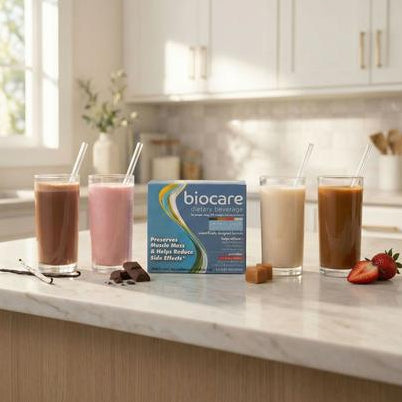
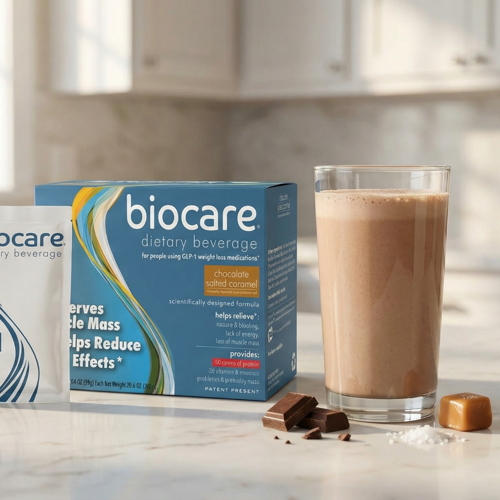
Biocare was made for exactly this problem: getting real nutrition in when appetite is low. Each single-serve shake delivers 30 grams of complete protein, 6 grams of fiber, and 26 vitamins and minerals, plus 1 gram of creatine monohydrate and 500 mg of added L-leucine to support muscle maintenance, and a probiotic and prebiotic fiber blend that supports digestive regularity.
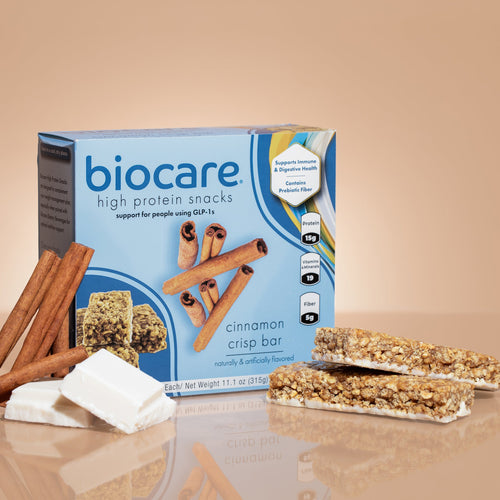
It mixes with 7 ounces of cold water in a shaker — no blender, no measuring. And because the range includes breakfasts, entrées, bars, and snacks alongside the shakes, you are not trying to build a whole day out of one format.
Browse the 30-gram protein shakes, or see how they slot into a week with our protein meal plans.
GLP-1 diet plan questions, answered
How many meals a day should I eat on a GLP-1 diet plan?
Most people do better with more, smaller eating occasions — often four or five — because total volume is the limiting factor. If three meals works for you and you are hitting your protein target, there is no reason to change it.
Do I need to count calories on a GLP-1?
Usually not, and many people find it counterproductive. The medication already reduces intake substantially. Tracking protein tends to be far more useful than tracking calories, because protein is the thing most likely to fall short. Discuss your own targets with your provider.
What should I eat first thing in the morning?
Something with protein, and ideally something cold. Mornings are when appetite is often lowest, and a smooth cold shake or Greek yogurt asks much less of you than eggs and toast. Getting 20–30 grams of protein in early means the rest of the day has less to make up.
Can I still eat carbohydrates on a GLP-1 diet plan?
Yes. Nothing is off the table. The reason protein gets emphasized is arithmetic, not virtue: when you can only eat a small amount, protein and fiber are the hardest targets to reach, so they earn priority on the plate. Carbohydrates you enjoy, especially fiber-rich ones, belong in the plan.
Should I be taking a multivitamin?
It is a reasonable question to raise with your provider, particularly if you are eating substantially less than before. A smaller volume of food means fewer micronutrients arriving each day. Some people cover the gap through fortified nutrition products, others through a supplement, and many use both. Your provider can look at your labs and advise.
How much water should I drink?
More than you think, and more than you feel like. Food normally supplies a meaningful share of your daily fluid, so eating less means drinking more to stay even. Sipping steadily between meals works better than large volumes with food, which takes up space you need. Adding electrolytes supports normal fluid balance on lower-intake days.
What happens to the plan when I stop the medication?
Appetite generally returns, and the habits you built become the thing carrying you. Protein at every meal, fiber daily, and consistent hydration are worth keeping whether or not you are still injecting. Talk to your provider before making any change to your medication.
Is a GLP-1 diet plan different from a regular healthy diet?
In principle, no — the same foods are good for you either way. In practice, the constraint is completely different. A regular healthy diet assumes you can eat a normal volume and asks you to choose well within it. A GLP-1 diet plan assumes you cannot, and asks every bite to do more work.
Sources
- U.S. Departments of Agriculture and Health and Human Services. Dietary Guidelines for Americans, 2020–2025. dietaryguidelines.gov
- Harvard T.H. Chan School of Public Health, The Nutrition Source. Protein. nutritionsource.hsph.harvard.edu
- National Institute on Aging, National Institutes of Health. Healthy Eating as You Age: Know Your Food Groups. nia.nih.gov
- National Institutes of Health, Office of Dietary Supplements. Nutrient Recommendations and Databases. ods.od.nih.gov
These statements have not been evaluated by the Food and Drug Administration. This product is not intended to diagnose, treat, cure, or prevent any disease. Always consult your physician or healthcare provider before making changes to your health or diet program.
Individual results vary and are not typical or guaranteed.
Ozempic® and Wegovy® are registered trademarks of Novo Nordisk A/S. Mounjaro® and Zepbound® are registered trademarks of Eli Lilly and Company. Biocare Nutrition is not affiliated with, endorsed by, or sponsored by Novo Nordisk A/S or Eli Lilly and Company. These names are used only to describe the category of medication our nutrition products are designed to accompany.
Fuel smarter. Feel stronger. Live better.