High-protein breakfast meal prep that actually gets eaten
Seven make-ahead mornings, a 25-minute Sunday routine, and what to do on the days you open the fridge and want none of it.
The short answer: high-protein breakfast meal prep works best when you build around one anchor protein — Greek yogurt, cottage cheese, eggs, or a protein beverage — and prep it in single servings rather than one big batch. Aim for roughly 25 to 30 grams of protein in the meal, add a fiber source, and keep two or three options in rotation so you always have something that sounds good.
The whole thing takes about 25 minutes on a Sunday and covers five mornings.
Why high-protein breakfast meal prep is worth the 25 minutes
Breakfast is the meal most likely to get skipped, and it is also the one where protein is easiest to miss. Cereal, toast, a banana, coffee — a typical morning can land under 10 grams before you have really started the day.
That matters because protein intake spread across the day supports muscle maintenance, and morning is the longest stretch most people go without it. Harvard's Nutrition Source notes that protein is a component of every cell in the body and is used continuously for repair and rebuilding (Harvard T.H. Chan School of Public Health).
If you are eating on a GLP-1 medication, there is a second wrinkle: morning is often when appetite is lowest. A breakfast that requires cooking, decisions, or standing at the stove is a breakfast that does not happen. Prepped single servings remove every one of those steps. Not sure what your daily number should be? Run it through the Biocare Protein Calculator.
What counts as a high-protein breakfast?
Most dietitians put the floor around 20 grams, with 25 to 30 grams as a comfortable target for a meal you want to carry you a few hours. Rather than memorizing recipes, build every breakfast from the same three slots:
1. An anchor protein
The piece doing the heavy lifting — 15 to 30 grams on its own. Greek yogurt, cottage cheese, eggs, a protein beverage, or a prepped protein like turkey sausage.
2. A fiber source
Oats, chia, berries, hemp hearts, or whole grain. Fiber supports digestive regularity and gives the meal some staying power. The Fiber Calculator will give you a daily number to work toward.
3. Something you actually want
Cinnamon, maple, peanut butter, hot sauce, real fruit. This slot is not optional. The most nutritionally perfect breakfast in the world is worth nothing sitting in the fridge on Thursday.
7 high-protein breakfast meal prep ideas
Each of these keeps for at least three days, travels well, and needs no morning decision-making. Four are egg-free, tagged below — useful if you are cooking for someone who does not eat eggs, or if eggs have simply stopped appealing to you.
Protein overnight oats
Half a cup of rolled oats, three-quarters of a cup of plain Greek yogurt, a splash of milk, a tablespoon of chia. Jar it, refrigerate, eat cold or warmed. Keeps four days.
Cottage cheese bowls
A cup of cottage cheese portioned into containers. Savory with tomato and everything seasoning, or sweet with berries and a drizzle of honey. Assemble two of each so you can pick by mood.
Egg and sausage muffin cups
Whisked eggs and turkey sausage baked in a muffin tin. Four cups is a serving. Refrigerate five days or freeze for a month; 45 seconds in the microwave brings them back.
Freezer breakfast burritos
Eggs, black beans, cheese, and salsa in a whole wheat tortilla. Wrap in foil, freeze flat. The highest-effort option here and the one people are gladdest about in week three.
Baked protein oatmeal squares
A tray of baked oatmeal cut into squares. Made with Greek yogurt instead of eggs, it stays egg-free. Pair a square with milk or a shake to get the meal over 25 grams.
Shake-and-go mornings
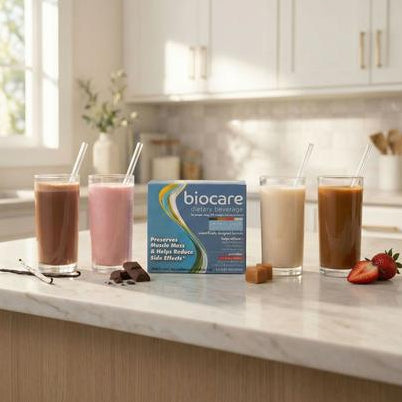
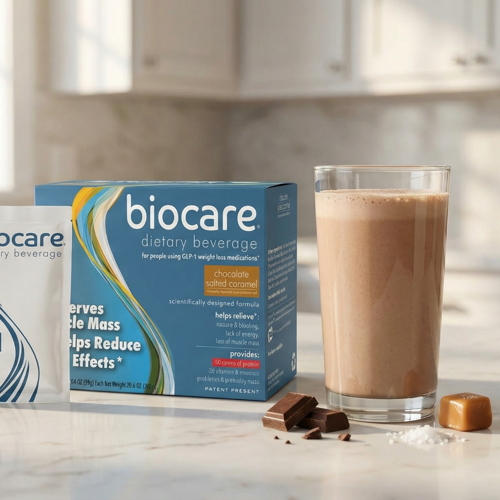
A single-serve Biocare beverage packet mixed with water — 30 grams of protein, 6 grams of prebiotic fiber, and 26 vitamins and minerals across two servings. Zero prep, which is the point on the mornings that got away from you.
Hot oatmeal packets
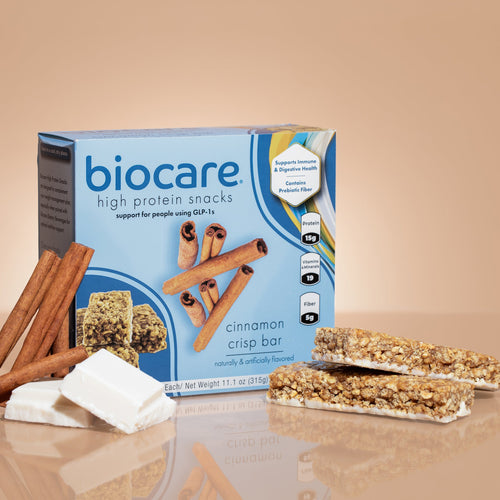
Biocare's maple brown sugar protein oatmeal — mix with water, microwave, done in a few minutes. Egg free, nut free, and warm, which matters more on cold mornings than any macro does.
High-protein breakfast options at a glance
Figures below are approximate and shift with brand, portion, and what you add on top. They are here so you can compare options, not as targets to hit.
| Breakfast | Protein | Fiber | Calories (approx.) | Keeps |
|---|---|---|---|---|
| Protein overnight oats | ~28 g | ~7 g | 330–380 | 4 days, fridge |
| Cottage cheese bowl | ~25 g | ~3 g | 200–260 | 3 days, fridge |
| Egg & sausage muffin cups (4) | ~24 g | <1 g | 260–300 | 5 days / 1 month frozen |
| Freezer breakfast burrito | ~26 g | ~6 g | 380–450 | 1 month, freezer |
| Baked oatmeal square | ~15 g | ~4 g | 210–250 | 5 days, fridge |
| Biocare beverage | 30 g | 6 g | 130–170 | Shelf-stable |
| Biocare protein oatmeal | 15 g | 3 g | ~150 | Shelf-stable |
If you are looking for the lower-calorie end of the range, the cottage cheese bowl and the single-serve beverage do the most protein per calorie. That does not make them better breakfasts — it makes them useful on the days a heavier meal does not appeal.
A 25-minute Sunday, start to finish
The order matters here — oven first, so everything else happens while it runs.
- Oven on, tray in (0:00)Preheat to 375°F. Whisk your eggs, stir in the sausage, fill the muffin tin, and get it in. It bakes unattended for about 20 minutes.
- Jar the overnight oats (0:05)Four jars, assembly line. Oats, yogurt, milk, chia in each. Lids on, straight to the fridge. Do not stir; they sort themselves out overnight.
- Portion the cottage cheese (0:12)Four containers. Leave the toppings off — add them in the morning so nothing goes soft.
- Stage the grab-and-go (0:16)Put your shake packets and oatmeal packets somewhere visible. A shelf, a basket, the counter. The ones you cannot see do not get eaten.
- Pull the tray, cool, pack (0:20)Muffin cups out, ten minutes to cool, then into containers. Label with the day if that helps you actually rotate through them.
Want the whole week mapped, not just breakfast? The Biocare protein meal plans lay out days at 60, 90, and 120 grams of protein, and there are more make-ahead ideas in our recipe collection.
What to do on the mornings you want none of it
Every meal prep guide assumes you will want the food you made. Some mornings you will not — appetite moves around, and it moves more when you are on a GLP-1 medication or your sleep has been bad or you are simply not a breakfast person that week.
A few things that help more than pushing through:
Go liquid
A shake often goes down when solid food will not. It is an easy way to get nutrition in when appetite is low, and it counts just as much as a plate.
Move it later
Breakfast does not have to happen at 7am. Prepped food keeps. Eating it at 10:30 is not a failure of the system, it is the system working.
Split it
Half the jar now, half mid-morning. Two smaller sittings are often easier than one, and the protein still lands.
Where Biocare fits
Biocare makes high-protein, shelf-stable food and beverages built for people eating less but needing more from every bite. In a breakfast rotation, they cover the mornings prep does not.
- 30 grams of protein per beverage serving to support muscle maintenance
- 6 grams of prebiotic fiber plus probiotics — fiber supports digestive regularity
- 26 vitamins and minerals across two servings, useful when portions are smaller
- Single-serve and shelf-stable — no fridge, no measuring, no decision
Browse the breakfast range or see the 30g protein shakes when you are ready.
Biocare is a food and dietary supplement, not a medication, and is not a substitute for the guidance of your healthcare provider.
High-protein breakfast questions, answered
How much protein should a high-protein breakfast have?
Most guidance puts the floor around 20 grams, with 25 to 30 grams as a comfortable target for a meal meant to carry you a few hours. Your overall daily number depends on body size, activity, and age — the protein calculator will give you a personalized starting point.
How do I meal prep a high-protein breakfast without eggs?
Anchor on dairy or a protein beverage instead. Greek yogurt overnight oats, cottage cheese bowls, baked oatmeal made with yogurt, and single-serve protein beverages all clear 15 to 30 grams with no eggs involved. Four of the seven ideas above are egg-free for exactly this reason.
Can I meal prep breakfast if I am on a GLP-1 and barely hungry in the morning?
Yes, and it tends to help more, not less. When appetite is low, the barrier is usually effort and decision-making rather than the food itself. Prepping in single servings means breakfast is a container you open. Keep at least one liquid option in the rotation for the mornings solid food does not appeal, and talk with your healthcare provider about what your nutrition needs look like.
How long does prepped breakfast keep?
Overnight oats hold about four days refrigerated, cottage cheese bowls about three, and egg muffin cups about five. Burritos and egg cups freeze well for a month. Shelf-stable packets keep in the pantry, which is why they are worth having as a backstop.
What is a low-calorie high-protein breakfast?
Options that deliver the most protein per calorie: a plain cottage cheese bowl lands around 200 to 260 calories with roughly 25 grams of protein, and a single-serve protein beverage runs 130 to 170 calories with 30 grams. Both are useful when a heavier meal does not appeal — but eating enough matters as much as eating less, so use these as options rather than defaults.
Is a protein shake a good breakfast?
It can be a genuinely good one, particularly a formulated beverage that brings vitamins, minerals, and fiber alongside the protein rather than protein alone. Shakes are also the easiest thing to get down on a low-appetite morning. Rotating them with solid options keeps variety in the week.
Do I need to eat breakfast at all?
There is no rule that says you do. What matters more is whether you are meeting your protein and nutrient needs across the whole day. If you routinely skip breakfast and find the rest of the day does not make up the gap, moving some protein earlier is worth trying. If it does make up the gap, you are fine.
Sources
- Harvard T.H. Chan School of Public Health, The Nutrition Source — Protein
- National Institute on Aging (NIH) — Healthy Eating, Nutrition, and Diet
- U.S. Departments of Agriculture and Health and Human Services — Dietary Guidelines for Americans
Fuel smarter. Feel stronger. Live better.
*These statements have not been evaluated by the Food and Drug Administration. This product is not intended to diagnose, treat, cure, or prevent any disease. Always consult your physician or healthcare provider before making changes to your health or diet program.
Individual results vary and are not typical or guaranteed.
Biocare Nutrition is not affiliated with, endorsed by, or sponsored by the manufacturers of any GLP-1 medication. Ozempic® and Wegovy® are registered trademarks of Novo Nordisk A/S. Mounjaro® and Zepbound® are registered trademarks of Eli Lilly and Company. All trademarks are the property of their respective owners.