Constipation on a GLP-1: foods and habits that support regularity
If things have slowed down since you started, you're not imagining it. Here's why it happens and the simple, food-first habits that support regular digestion.
When you're eating less on a GLP-1, you often take in less fiber and less fluid, and these medications slow digestion — a combination that can affect how regular you are. The reassuring part: fiber, fluids, and daily movement all support digestive regularity. Small, steady habits — not a dramatic overhaul — tend to make the biggest difference.
Why regularity can change on a GLP-1
Two things tend to happen at once. First, GLP-1 medications like semaglutide and tirzepatide slow how quickly food moves through your stomach — that's part of how they curb appetite. Second, because you're eating less overall, it's easy to take in less fiber and less fluid than your body is used to.
Fiber and fluid are two of the biggest levers for regular digestion, so when both drop at the same time, it's common for things to slow down. Understanding that is the whole game: the habits that support regularity are the same ones that get harder when appetite shrinks, which means they're worth being intentional about.
How much fiber do you actually need?
For most adults, the general target is roughly 25 to 34 grams of fiber a day, from a mix of fruits, vegetables, whole grains, and legumes. Two practical notes matter more than the exact number:
Add fiber gradually. A sudden jump can leave you gassy or bloated. Build up over a week or two so your system can adjust. And pair it with fluids. Fiber works by drawing water into the digestive tract, so more fiber without more water can backfire. The two go together.
Not sure where you land? Our fiber calculator gives you a personalized daily target in about a minute.
Fluids and movement matter just as much
Water helps keep things moving, and it's easy to under-drink when you're not eating much. Sipping steadily through the day — not just at meals — supports regular digestion. Gentle daily movement helps too: a walk after meals encourages the natural muscle activity of the digestive tract. None of this has to be dramatic; consistency beats intensity.
6 habits that support digestive regularity
Aim for ~25–34g fiber
From fruits, veg, whole grains, and legumes across the day.
Mix your fiber
Both soluble (oats, beans) and insoluble (whole grains, veg) support regularity.
Drink steadily
Fiber pulls water into the gut, so fluids and fiber work as a pair.
Move daily
A short walk helps encourage the gut's natural muscle activity.
Go gradual
Build fiber up over a week or two to avoid gas and bloating.
Keep easy options
Fiber-and-hydration products make it simple to fill gaps on low-appetite days.
A simple plan to support regularity
-
Find your fiber number
Start with a personalized target from the fiber calculator so you know what you're aiming for.
-
Add fiber gradually, with fluid
Increase over a week or two and drink water alongside it — the two work together, and going slow avoids bloating.
-
Build fiber into meals you'll actually eat
Fruit, veg, beans, and whole grains. Our GLP-1 recipes make fiber-forward meals easy when cooking energy is low.
-
Keep easy fiber and hydration on hand
For low-appetite days, our fiber & hydration options help you get fiber and fluids in without a big meal.
-
Move a little, daily
A gentle walk, especially after eating, supports regular digestion.
-
Talk to your provider if it persists
If changes don't help, or you have significant discomfort or other symptoms, check in with your healthcare provider.
Fiber and fluids, made easy for low-appetite days
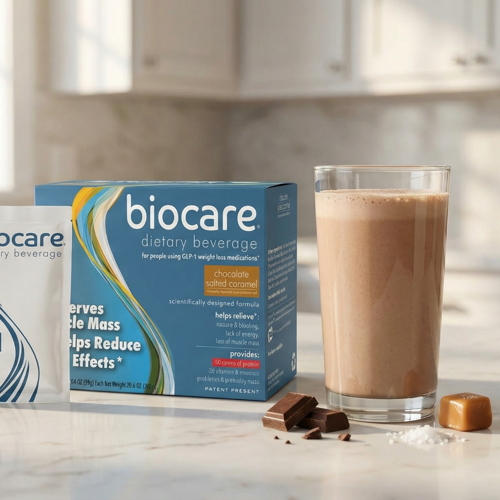
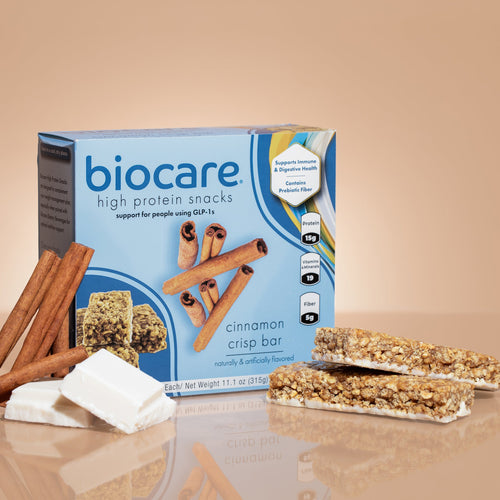
The habits that support regularity — enough fiber and enough fluid — are exactly the ones that get harder when you're eating less. That's where Biocare helps: our fiber and hydration options make it simple to get fiber and fluids in without a full meal. Fiber supports digestive regularity, so having an easy way to reach your daily fiber and hydration is one of the more useful habits to build on a GLP-1.
Explore fiber & hydrationFrequently asked questions
Why am I constipated on a GLP-1?
Does fiber help with regularity?
How much fiber should I aim for?
Should I drink more water with more fiber?
Can I add too much fiber too fast?
When should I see a doctor?
Keep going
Sources
- National Institute of Diabetes and Digestive and Kidney Diseases (NIDDK) — Symptoms & Causes of Constipation; Eating, Diet & Nutrition for Constipation. niddk.nih.gov
- U.S. Departments of Agriculture and Health & Human Services — Dietary Guidelines for Americans, 2020–2025 (dietary fiber). dietaryguidelines.gov
These statements have not been evaluated by the Food and Drug Administration. This product is not intended to diagnose, treat, cure, or prevent any disease. Always consult your physician or healthcare provider before making changes to your health or diet program.
Biocare is not affiliated with, endorsed by, or sponsored by the makers of Ozempic®, Wegovy®, Mounjaro®, or Zepbound®. All trademarks are the property of their respective owners.
Fuel smarter. Feel stronger. Live better.