What is GLP-1, and how does it actually work?
The hormone behind the medication, in plain language — what it does in your body and why it changes the way you eat.
GLP-1 is a hormone your gut releases after you eat. It tells your pancreas to release insulin, slows how quickly your stomach empties, and signals your brain that you're full. GLP-1 medications like semaglutide and tirzepatide are built to mimic that hormone and make the effect last far longer than your body's own version — which is why appetite drops and digestion slows.
What is GLP-1?
GLP-1 stands for glucagon-like peptide-1. It's a hormone your body makes naturally — released by cells in your intestine after you eat. It belongs to a group called incretin hormones, whose job is to help manage blood sugar and signal fullness in response to food.
Here's the catch with the natural version: it doesn't stick around. Your body breaks down GLP-1 within minutes, so its effects are brief. That short lifespan turns out to be the key to understanding how the medications are different.
What does GLP-1 do in your body?
Natural GLP-1 works on a few systems at once, all pointing toward steadier blood sugar and a sense of having eaten enough:
Made in your gut
Released by cells in your intestine in response to food.
After you eat
Levels rise several-fold once nutrients arrive, then fall again.
Prompts insulin
Signals the pancreas to release insulin when blood sugar is up.
Slows the stomach
Delays how fast the stomach empties, spreading digestion out.
Signals fullness
Acts on appetite centers in the brain to increase satiety.
Balances glucagon
Reins in glucagon, a hormone that raises blood sugar.
How do GLP-1 medications work?
GLP-1 medications are engineered versions of that same hormone. Because natural GLP-1 breaks down in minutes, the medications are designed to resist that breakdown — so instead of a brief signal, they keep working for days, which is why many are taken just once a week.
The result is that the hormone's everyday effects — slower digestion, feeling full sooner, a quieter appetite — are sustained rather than fleeting. That's what leads to eating less, and, for many people, changes in blood sugar and weight. (Tirzepatide works on a second gut hormone, GIP, in addition to the GLP-1 pathway.) These are prescription medications, and whether one is right for you is a conversation for you and your healthcare provider.
What this means for how you eat
Once you understand the mechanism, the nutrition side makes sense. When appetite is quieter and your stomach empties more slowly, you naturally eat smaller amounts and feel full faster. That's the intended effect — but it also makes it easy to fall short on protein, fiber, and fluids without realizing it.
Because the medication also slows digestion, eating past the point of fullness can feel uncomfortable, so many people do better with smaller, protein-forward meals spread across the day. The theme is the same throughout your journey: when you're eating less, making what you do eat count matters more.
Making the most of a smaller appetite
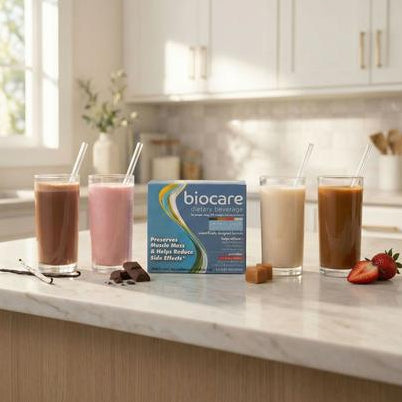
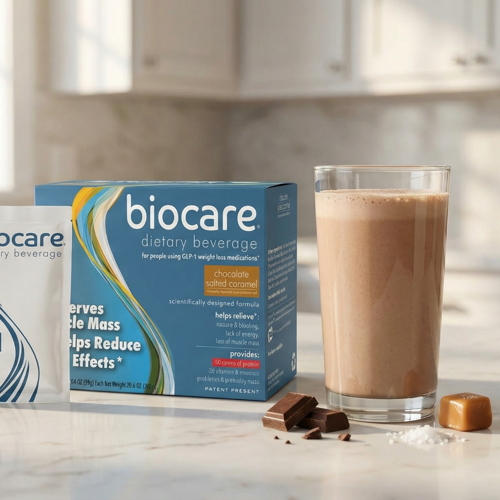
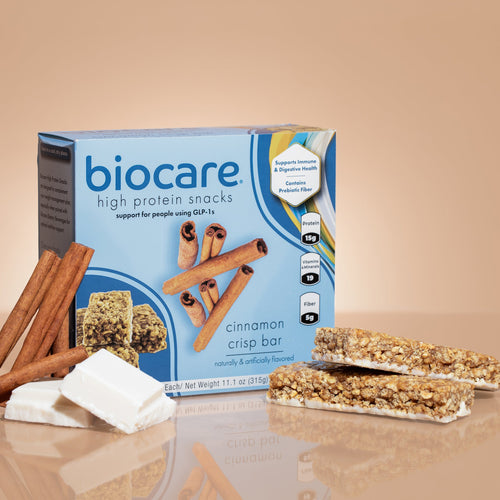
Biocare doesn't change how your medication works — that's between you and your provider. What we do is make the nutrition part easier. When appetite is low, our protein shakes, high-protein meals, and fiber and hydration options help you get quality nutrition in without a lot of volume or effort. Protein supports muscle maintenance and fiber supports digestive regularity — two things worth protecting while you're eating less.
See what to eat on a GLP-1Frequently asked questions
What does GLP-1 stand for?
Is GLP-1 a hormone or a medication?
How is the medication different from my body's own GLP-1?
Why do GLP-1s reduce appetite?
Why do I sometimes feel queasy if I eat too much?
Should I change how I eat on a GLP-1?
Keep going
Sources
- Cleveland Clinic — GLP-1 Agonists: What They Are, How They Work & Side Effects. my.clevelandclinic.org/health/treatments/13901-glp-1-agonists
- National Institutes of Health (NCBI/StatPearls) — Glucagon-Like Peptide-1 Receptor Agonists. ncbi.nlm.nih.gov/books/NBK572151/
These statements have not been evaluated by the Food and Drug Administration. This product is not intended to diagnose, treat, cure, or prevent any disease. Always consult your physician or healthcare provider before making changes to your health or diet program. GLP-1 medications are prescription drugs; decisions about them should be made with your healthcare provider.
Biocare is not affiliated with, endorsed by, or sponsored by the makers of Ozempic®, Wegovy®, Mounjaro®, or Zepbound®. All trademarks are the property of their respective owners.
Fuel smarter. Feel stronger. Live better.