Nutrient density on a GLP-1: why every bite counts
When your appetite drops, the amount of food on your plate shrinks — but your body's need for protein, fiber, and micronutrients doesn't. Here's how to make less food go further.
Nutrient density on a GLP-1 means getting more nutrition out of every bite, because there are fewer bites overall. Appetite suppression from medications like semaglutide and tirzepatide can cut daily intake substantially, which makes it harder to reach your usual protein, fiber, and vitamin targets from food volume alone. The practical fix is to prioritize foods and beverages that carry a lot of nutrition in a small serving.
What does nutrient density actually mean?
Nutrient density is the amount of nutrition — protein, fiber, vitamins, minerals — packed into a given amount of food or calories. A handful of almonds and a handful of pretzels are similar in volume, but they are not remotely similar in what they deliver.
Most of the time this is a background concern. You eat a normal amount of food, and the nutrition mostly takes care of itself. On a GLP-1, it moves to the foreground, because the total volume you can comfortably eat has changed and everything you do eat has to work harder.
The goal isn't eating more. It's getting more out of what you eat.
Why eating less on Ozempic or Zepbound makes nutrition harder
Three things tend to happen at once, and they compound:
Fewer calories, fewer nutrients
Smaller portions can mean less protein, fiber, and micronutrients than you were getting before — not by intention, just by volume.
Not every shake is built for it
Many retail protein shakes run light on fiber and added micronutrients. They solve for protein and stop there.
Every serving does more work
When there's less on the plate, nutrient density stops being a nice-to-have and becomes the whole strategy.
What a nutrient-dense serving looks like
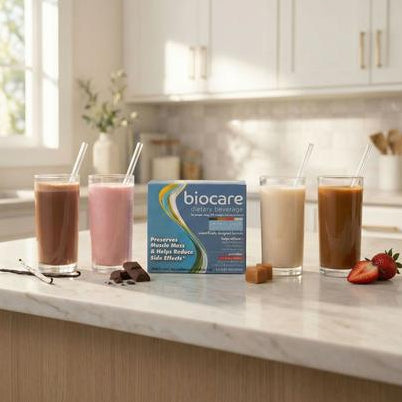
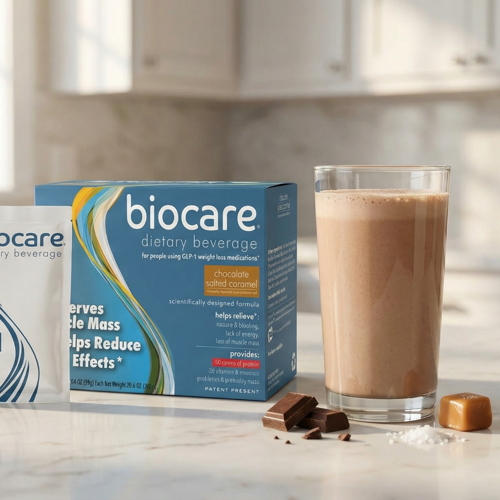
Here's the same idea in numbers. One serving of Biocare is built to carry protein, fiber, and micronutrients together, rather than solving for one and leaving the others to chance.
Side by side, per serving. Retail shake figures reflect typical ranges across the category, not any single brand.
| Per serving | Many retail shakes | Biocare |
|---|---|---|
| Protein | 20–25g typical, often from a single source | 30g multi-source whey and casein blend |
| Fiber | Frequently under 3g, sometimes none | 6g prebiotic fiber plus probiotics |
| Micronutrients | Limited or variable by brand | 26 vitamins and minerals |
| Fats | Often minimal or added sugar-forward | MCTs and flaxseed for plant-based omega-3s |
How do I eat for nutrient density on a GLP-1?
- Start with your actual protein number. "More protein" isn't a target. Run your weight and activity through the protein calculator and work backward from a real number.
- Anchor protein first at every meal. If you only manage a few bites, you want those bites to be the protein. Everything else is easier to catch up on later in the day.
- Don't let fiber fall off the list. Fiber tends to vanish quietly when portions shrink. The fiber calculator gives you a target to aim at.
- Use liquid nutrition on the low-appetite days. On days when solid food genuinely doesn't appeal, a fortified shake is often the most realistic way to get nutrition in at all.
- Plan the week, not the meal. Decisions made at 6pm on an empty tank are rarely nutrient-dense ones. Our meal plans and GLP-1 recipes take the decision out of the moment.
Where Biocare fits
Biocare was formulated for exactly this situation: nutrition that has to do more, in a serving that has to be smaller. Each shake brings 30 grams of complete protein, 26 vitamins and minerals, and 6 grams of prebiotic fiber together in one glass — so a day with a small appetite doesn't have to be a day with thin nutrition.
It's not a replacement for eating well. It's a way to keep your nutrition steady on the days when eating well is genuinely hard.
Explore the shakesFrequently asked questions
What is nutrient density and why does it matter more on a GLP-1?
Nutrient density is how much nutrition — protein, fiber, vitamins, minerals — a food delivers relative to its volume or calories. It matters more on a GLP-1 because appetite suppression reduces how much you eat overall, so each serving has to contribute more toward your daily needs.
How much protein should I aim for on a GLP-1?
It depends on your body weight, activity level, and what your provider recommends. Rather than guessing, use the Biocare protein calculator for a personalized daily number, and confirm it with your healthcare provider.
Are protein shakes better than food for GLP-1 nutrition?
Neither is better in the abstract. Whole food is a great foundation when you can eat it comfortably. A fortified shake is useful on the days when volume is the limiting factor, because it delivers a lot of nutrition in a small, easy serving. Most people end up using both.
What should I look for on a shake label?
Look at protein amount and protein source, fiber content, and whether vitamins and minerals are actually added. A shake with 30 grams of protein and no fiber or micronutrients is solving one third of the problem. Our guide to what to look for in a protein supplement goes deeper on protein types.
Why does fiber matter when I'm eating less?
Fiber is one of the first things to drop out when portions shrink, because it mostly comes from higher-volume foods like vegetables, fruit, and whole grains. Fiber supports digestive regularity, so it's worth tracking deliberately rather than assuming you're getting enough.
Can I use Biocare while taking semaglutide or tirzepatide?
Biocare is a dietary beverage, not a medication, and it's formulated with reduced-appetite eating in mind. As with any change to your nutrition while on a prescription medication, talk to your physician or healthcare provider about what fits your situation.
Do I still need to think about micronutrients if I take a multivitamin?
A multivitamin can help, and many people on reduced-calorie intakes take one. It's still worth paying attention to what your food and beverages contribute, and worth reviewing with your provider — especially if your intake has changed a lot.
Keep reading
Sources
- National Institute on Aging, Healthy Meal Planning Tips — on prioritizing nutrient-dense foods when appetite or intake is reduced.
- Harvard T.H. Chan School of Public Health, The Nutrition Source: Protein — on protein quality and dietary sources.
Fuel smarter. Feel stronger. Live better.
These statements have not been evaluated by the Food and Drug Administration. This product is not intended to diagnose, treat, cure, or prevent any disease. Always consult your physician or healthcare provider before making changes to your health or diet program. Individual results vary and are not typical or guaranteed.
Biocare is not affiliated with, endorsed by, or sponsored by the makers of Ozempic®, Wegovy®, Mounjaro®, or Zepbound®. All trademarks are the property of their respective owners and are referenced for identification purposes only.
Comparison figures for retail shakes reflect general ranges observed across the category and are not a claim about any specific competing product.