GLP-1 Summer Survival: 4 Things to Lock In Before the Heat Hits
Heat changes everything on a GLP-1. Your appetite drops more, hydration gets harder, and the routines that carried you through spring start to fall apart. Here's how to stay ahead — built from real GLP-1 experience, backed by science.
If you started a GLP-1 medication this spring, you've probably found a rhythm by now. You know which foods sit well. You've figured out your protein workarounds. You've stopped panicking every time the scale doesn't move.
Then summer shows up.
And suddenly the chicken thigh you were eating three nights a week makes you nauseous just looking at it. You're constantly tired and you can't figure out why. The water bottle that lived on your desk somehow isn't enough anymore. And every weekend has a cookout, a pool party, or a vacation that doesn't fit your routine.
Here's the truth nobody tells you when they prescribe Zepbound, Mounjaro, Wegovy, or Ozempic: summer is the hardest season to be on a GLP-1. Not because anything is wrong — but because the conditions that make weight management harder all stack up at the same time.
This guide is your June game plan. Four specific things to lock in before the heat fully hits — built from real GLP-1 user experience, backed by what the research actually says about appetite suppression, dehydration risk, and muscle preservation during weight loss.
Save it. Send it to the friend who just started. Come back to it the next time you're standing in your kitchen at 7pm wondering why you can't eat anything.
Why summer is harder on a GLP-1
Before we get into the playbook, it helps to understand what's actually happening to your body. GLP-1 medications work by slowing gastric emptying, reducing appetite, and improving insulin response. All three of those mechanisms interact with hot weather in ways that compound your existing side effects.
Heat further suppresses appetite
Your body naturally reduces appetite in high heat — it's a survival mechanism to avoid generating extra heat from digestion. Layer that on top of the 60-80% appetite suppression most GLP-1 users already experience, and you can easily go a full day forgetting to eat. That sounds harmless, but it's how muscle loss accelerates and energy crashes happen.
Hydration becomes a daily risk, not a daily goal
GLP-1s weaken thirst cues — many users report not feeling thirsty even when they're clearly dehydrated. Combine that with summer sweat losses and you have a recipe for chronic, low-grade dehydration that worsens nausea, fatigue, and constipation. Most ER visits for dehydration in GLP-1 users happen between June and September.
Social food situations multiply
June through August packs in Father's Day, Fourth of July, Labor Day, plus weddings, vacations, and the constant rhythm of weekend cookouts and pool parties. Each one is a chance for your routine to slip, your protein intake to crash, and your stress around food to spike.
Now the playbook.
1. Build a hydration system — not just a habit
Most GLP-1 users know they need to drink more water. The problem isn't knowledge — it's that thirst cues are unreliable on these medications. Relying on "I'll drink when I'm thirsty" is exactly how you end up dehydrated by 2pm.
The fix is to remove the decision entirely. Build a system, not a habit. Habits depend on remembering. Systems work even when you forget.
Your hydration system
- Pick one hydration drink you actually enjoy (electrolytes matter — plain water alone often isn't enough during summer GLP-1 use)
- Pre-portion it the night before so morning-you doesn't have to think
- Stage one serving in your bag, one at your desk, one in the fridge
- Set two phone alarms: one at 10am, one at 2pm — non-negotiable refill points
The benchmark to aim for: half your body weight in ounces, daily, minimum. So if you weigh 180 pounds, that's 90 oz of fluid every single day — more if you're sweating outdoors. Track it for one week and you'll be shocked how often you fall short.
2. Stock cold, soft, ready-to-eat protein
Here's a conversation we hear constantly: "In April I was eating chicken three times a week. Now in June, the smell makes me gag. What happened?"
What happened is that GLP-1-induced nausea plus heat changes what foods feel tolerable. Dense, warm, high-effort proteins become harder to face. The chicken thigh that worked in spring becomes the thing you can't choke down in July.
The solution is to stock alternatives now — before the day you can't eat anything else.
Cold, soft, ready-to-eat protein sources
- Greek yogurt (20g protein per cup, no chewing required)
- Cottage cheese (24g per cup, surprisingly versatile)
- Smoked salmon (sliced thin, doesn't require cooking)
- Hard-boiled eggs (batch-cook 8 on Sunday, eat all week)
- Clear protein drinks (the most reliable backup when nothing else sounds good)
Speaking of clear protein — this is where a lot of GLP-1 users get stuck. Standard whey shakes are too thick and chalky when you're nauseous. Plant proteins often cause more bloating. We built biocare Mixed Berry Clear Protein specifically for this situation: 25g of protein, light and juice-like instead of milky, and gentle enough to sit well even on shot day. Keep a tub on the counter — it's the difference between hitting your protein and giving up by 4pm.
The rule we live by: if you can't chew it, drink it. Liquid protein is always your safety net. Never let yourself run out of an option.
3. Have a script for BBQs, trips & Aunt Linda
Summer social eating is where good intentions go to die — not because you can't make smart food choices, but because the emotional energy of explaining yourself to family members for the eighth time is exhausting.
Aunt Linda asking why you're "only eating that little." The uncle who keeps offering you a beer. The friend who pointedly says "oh I forgot, you can't have that anymore." Every comment is small. Together they're a full-time job.
Decide your responses now, before you're at the picnic table trying to think on your feet. Here's a starter script:
Three lines that handle 90% of situations
- "I ate earlier, I'm just here for the company." — Use for: small portions, skipping the main spread, declining seconds. It ends the conversation without lying or explaining.
- "My doctor has me on a specific eating plan right now." — Use for: persistent questioners. Most people back off when "doctor" is invoked. You don't owe more detail than that.
- "I'm good, thanks!" — Use for: literally every other situation. It is a complete sentence.
The backup snack rule
Always bring something. A small cooler bag with single-serve clear protein, a piece of cheese, or even just a biocare hydration single-serve packet takes the stress off whether you'll find something to eat. You're not relying on the host. You're not depending on what's available. You've got you.
4. Lift heavy things — twice a week, minimum
This is the tip nobody wants to hear and everyone needs to.
The single most-cited concern about GLP-1 weight loss is muscle loss. The research is clear: when you lose weight quickly through caloric reduction alone, 20-40% of that loss can come from lean muscle mass. In summer, when food intake drops further from heat and you're more sedentary indoors, that number can climb even higher.
There's exactly one intervention proven to prevent this: resistance training. Not cardio. Not walking. Lifting things that are heavy enough to make your muscles work.
The minimum effective dose
- Two resistance sessions per week (full-body, 20-30 minutes each)
- Progressive load — that means slightly heavier or more reps than last time
- Hit each major muscle group: legs, back, chest, shoulders, core
- Eat protein within 2 hours of training (this is non-negotiable for muscle preservation)
You don't need a gym. You don't need a coach. Resistance bands, dumbbells, even bodyweight squats and push-ups count — as long as you're progressively challenging yourself.
The rule: cardio is for the heart. Resistance training is for the body you actually want to keep.
Where to start if you're overwhelmed
Reading four things to do feels manageable. Doing four things at once doesn't. So here's our honest advice on sequencing:
- Week 1: Hydration only. Pick your drink, pre-portion it, set the alarms. Get one week of consistency before adding anything else.
- Week 2: Add protein backup. Stock your fridge with at least three of the cold protein options above. Keep a tub of clear protein on the counter.
- Week 3: Write your social scripts. Practice saying them out loud. Pack your backup cooler bag.
- Week 4: Start resistance training. Two short sessions. Anything counts on week one — just start.
By the end of June, all four systems are in place. Not perfect — in place. That's the difference between people who thrive on a GLP-1 long-term and people who quit by month six.
Meet the new biocare 7-Pack
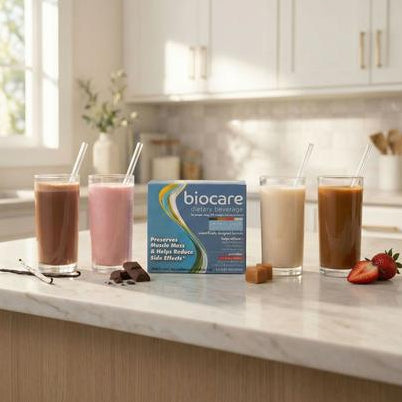
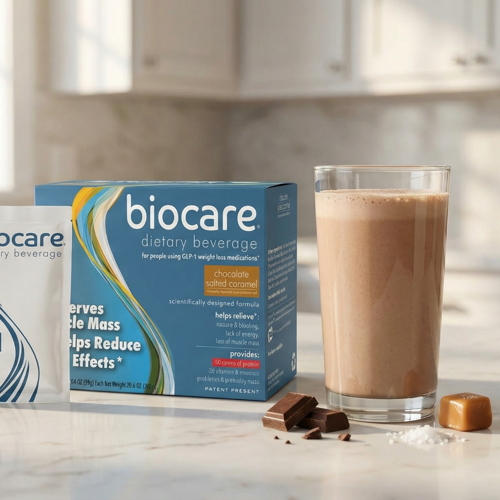
If you're locking in a new summer routine, the buy-in cost of a 14-pack can feel like a lot — especially when you're already paying for medication, labs, and a kitchen full of new foods. That's why we built the biocare 7-Pack: same clinically-informed formula, half the box, half the price. Made for people locking in a routine for the first time.
Try it. Build the habit. See how your body responds before committing to a bigger box. That's the version of starting we wish we'd been able to offer from day one.
Frequently Asked Questions
How much water should I drink on a GLP-1 in summer?
Half your body weight in ounces per day, minimum. If you weigh 180 pounds, that's 90 oz. Add 16-20 oz for every hour of outdoor activity or hot weather exposure. Electrolytes become important above 70 oz daily — plain water alone can actually flush minerals out of your system.
Why am I more nauseous on my GLP-1 in summer?
Three factors compound: heat naturally reduces appetite, GLP-1s already slow gastric emptying, and dehydration intensifies nausea. The fix is usually hydration first, then switching to cooler, softer protein sources, then timing your shot for an evening or low-heat day if possible. Always talk to your prescriber about persistent nausea.
Can I take a break from my GLP-1 during summer vacation?
This is a question for your prescriber — not us, not the internet. What we'll say is that most clinical guidance doesn't recommend pausing without medical input. The medication takes 4-8 weeks to fully ramp back up after a break, which means your vacation "break" can cost you months of progress. Plan around it instead of pausing it.
Will I lose muscle on a GLP-1?
Without intervention, yes — research shows 20-40% of weight lost on a GLP-1 can come from lean muscle. With resistance training twice a week and adequate protein intake (0.7-1g per pound of goal body weight), muscle loss drops dramatically. This isn't optional if you care about your long-term metabolism.
What's the best protein for GLP-1 users with nausea?
Cold, clear, light-textured proteins tend to be tolerated best. Whey isolate is gentler than concentrate (less lactose). Clear proteins like biocare Mixed Berry Clear Protein are often easier than milky shakes because they're less viscous and feel more like juice. Cottage cheese and Greek yogurt also tend to sit well. Avoid heavy red meat and dense chicken dishes when nausea is high.
Your summer, locked in
GLP-1 life is a lot. Summer GLP-1 life is more. But the four things in this guide — hydration, protein, social scripts, resistance training — are the difference between coasting through summer with your progress intact and watching three months of work unravel because the heat caught you off guard.
You don't have to do everything at once. You don't have to do anything perfectly. You just have to start.
Save this guide. Share it with anyone who needs it. And when you're ready to lock in your summer protein routine, the biocare 7-Pack is the easiest place to start.
We've got you.
Medical disclaimer: This content is for educational purposes only and does not constitute medical advice. Always consult your prescribing provider before making changes to your GLP-1 medication, exercise routine, or nutrition plan.