GLP-1 cost without insurance: what you’ll actually pay
The list price and the real price are very different numbers. Here are the four routes people use to bring the cost down — including Medicare’s new $50 copay program — and the questions to ask before you commit.
Brand-name GLP-1 medications list at roughly $1,000 to $1,350 a month, but very few people pay that. As of July 2026, the manufacturers’ own cash-pay programs sell them for roughly $150 to $500 a month depending on the drug and dose, commercial insurance plus a manufacturer savings card can bring a fill down to about $25, and eligible Medicare Part D members can now access certain GLP-1s for a flat $50 monthly copay through a federal program that launched July 1, 2026.
A note on the numbers. GLP-1 pricing has changed more often than almost any other category of medication over the past two years, and it will change again. Every figure here is a range, date-stamped July 2026, and meant to tell you which route is worth investigating — not to quote you a price. Always confirm the current cost directly with the manufacturer’s program, your pharmacy, or your plan before you budget.
Why the list price isn’t what most people pay
The list price is what the manufacturer publishes before any insurance, rebate, or discount program touches it. It’s the number that generates headlines, and it’s close to meaningless for an individual patient.
What you actually pay comes down to three things: whether your insurance covers the drug for weight management, whether you qualify for a manufacturer savings card, and whether buying directly from the manufacturer for cash beats using your insurance at all. For a fair number of people without coverage, that last option is now the cheapest route.
This matters for more than your budget. In a study of more than 125,000 US adults, lower income was linked to a higher likelihood of stopping GLP-1 treatment, and cost was among the most common reasons documented in patients’ own clinical notes. Sorting out a sustainable price is part of making the treatment work.
Four routes to a lower price
Insurance + savings card
If your commercial plan covers the drug for weight management, a manufacturer savings card is usually the cheapest option. Expect prior authorization, and often a documented history of other approaches first.
Manufacturer direct (cash)
Novo Nordisk sells Wegovy through NovoCare Pharmacy and Eli Lilly sells Zepbound through LillyDirect, both at steep discounts to list for self-pay patients. Oral options sit at the lower end of the range.
TrumpRx.gov
A federal site launched February 5, 2026 that routes you to the manufacturers’ own discount pages or generates a pharmacy coupon. It doesn’t sell drugs itself, and prices match the manufacturer programs.
Medicare GLP-1 Bridge
Launched July 1, 2026 for eligible Part D members. The first time Medicare has covered a medication specifically for weight management. Details in the next section.
State Medicaid programs are a fifth route, but coverage for weight management varies enormously from state to state and most do not cover it on that basis alone. Your state Medicaid office or a benefits counselor can tell you where yours stands.
How the Medicare GLP-1 Bridge program works
This is the biggest change in GLP-1 access in years, and it’s worth understanding properly because it works differently from normal Part D coverage.
- Check that you’re in an eligible plan. You need to be enrolled in an eligible stand-alone Part D plan or a Medicare Advantage plan with drug coverage. Your plan doesn’t have to opt in — the program runs outside Part D.
- Talk to your prescriber about the clinical criteria. Eligibility is based on a BMI of 35 or higher on its own, or 27 or higher combined with other clinical criteria. If you’re already on a GLP-1 for weight management, your prescriber can attest that you met the criteria when you started.
- Your prescriber submits a prior authorization. Requests go to a central processor that CMS has contracted Humana to manage, rather than to your own plan.
- Pay $50 at the pharmacy counter. Once approved, that’s a flat $50 for each 30-day supply. The covered medications are Wegovy (injection and tablet), the Zepbound KwikPen, and Foundayo.
Two things to weigh before you switch
Because the program sits outside the Part D benefit, the $50 copay does not count toward your Part D deductible or your annual out-of-pocket cap, and it can’t be spread out using the Medicare Prescription Payment Plan. If you’re already taking a GLP-1 for type 2 diabetes, cardiovascular risk reduction, or sleep apnea, you’ll keep getting it through your regular Part D coverage — which may cost more or less than $50.
The program is also temporary. It runs through the end of 2027, and the longer-term demonstration that was meant to follow it has been postponed. Worth factoring into a long-term plan.
What to ask before you commit
Whichever route you’re considering, these are the questions that change the answer. Bring them to your plan, your pharmacist, or your prescriber’s office.
- Does my plan cover this drug for weight management, or only for diabetes?
- What does prior authorization require, and how long does it take?
- Is the cash price through the manufacturer lower than my copay? (It sometimes is.)
- Does the price change when I move to a higher maintenance dose?
- Is the introductory price I’m being quoted a limited-time offer, and what does it become after?
- If I’m on Medicare, am I better off in the Bridge program or my regular Part D coverage?
- What happens to my price if I need to pause and restart later?
A word of caution on cheap “compounded” versions
During the shortages of 2023 and 2024, compounding pharmacies were permitted to make copies of semaglutide and tirzepatide, and a large online market grew up around them. That legal basis has largely ended now that the shortages are resolved, and the FDA has moved to further restrict it.
Sellers still advertising very low prices for “compounded” or imported GLP-1s are operating in a gray market where the product isn’t FDA-approved and dosing errors have been reported. Now that manufacturer cash prices have fallen substantially, the gap that made these sellers appealing has narrowed a lot. If you’re considering one, talk to your prescriber or pharmacist first.
The cost nobody budgets for
People plan for the prescription and then get surprised by the food.
Eating well on a much smaller appetite tends to mean buying differently, not just less — more protein-dense foods, fewer things that fill you up without giving you much. And when you can only manage a small amount, what’s in that small amount starts to matter more than it used to. That’s a line item worth putting in the plan alongside the medication.
Where Biocare fits
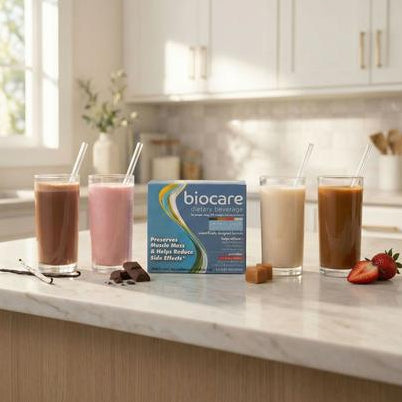
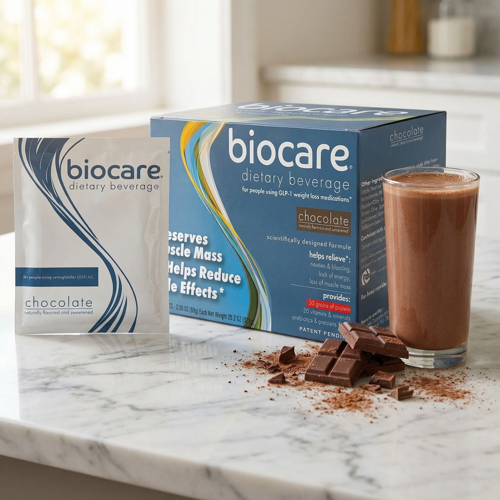
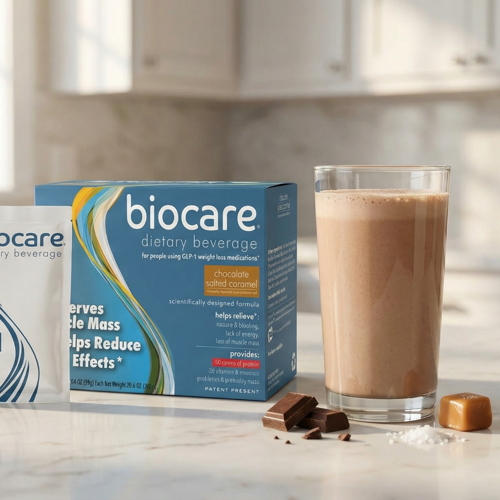
We’re a food company, not a pharmacy, and we can’t make your prescription cheaper. What we can do is make the nutrition side more predictable — whether you’re on a GLP-1, between fills, or not taking one at all.
- Protein supports muscle maintenance, which matters when you’re eating less overall.
- Fiber supports digestive regularity.
- Single-serve, shelf-stable formats mean no waste on the days your appetite doesn’t show up.
Start with the protein calculator for a daily target, or browse the 30-gram protein shakes. Talk with your healthcare provider about what’s right for you.
Questions people ask
How much does a GLP-1 cost without insurance in 2026?
List prices for brand-name GLP-1s run roughly $1,000 to $1,350 a month, but as of July 2026 the manufacturers’ own cash-pay programs sell them for roughly $150 to $500 a month depending on the drug, the dose, and whether you’re a new or continuing patient. Oral formulations generally sit at the lower end. Confirm the current price directly with the program before budgeting.
What is the cheapest way to get a GLP-1 without insurance?
For most self-pay patients it’s buying directly from the manufacturer — NovoCare Pharmacy for Wegovy, LillyDirect for Zepbound — or reaching those same prices through the TrumpRx.gov portal. Introductory offers on starter doses are often the lowest entry point, so ask what the price becomes once the offer ends.
Does Medicare cover GLP-1s for weight loss?
As of July 1, 2026, yes, through a temporary program called the Medicare GLP-1 Bridge. Eligible Part D members pay a flat $50 monthly copay for Wegovy (injection or tablet), the Zepbound KwikPen, or Foundayo. Because the program runs outside the Part D benefit, that copay doesn’t count toward your deductible or out-of-pocket cap. The program is scheduled to run through the end of 2027.
Does Medicaid cover GLP-1s for weight loss?
It depends heavily on your state. Most state Medicaid programs cover GLP-1s for type 2 diabetes but not for weight management alone, and the list of states that do changes. Your state Medicaid office is the reliable source.
What is TrumpRx and is it legitimate?
TrumpRx.gov is a federal website that launched February 5, 2026. It doesn’t sell medication — it directs you to the manufacturers’ own cash-pay pages or generates a coupon you can use at a retail pharmacy. The medication you receive is the same FDA-approved brand-name product, and the prices reflect the manufacturers’ negotiated self-pay rates.
Are compounded semaglutide and tirzepatide still available?
Largely not through legitimate channels. The permission that allowed compounding pharmacies to make copies during the shortages has mostly ended, and the FDA has moved to restrict it further. Sellers still advertising them are operating outside FDA approval. Talk to your prescriber or pharmacist before using one.
Why does cost matter for staying on a GLP-1?
Because it’s one of the main reasons people stop. In a cohort study of more than 125,000 US adults, lower income was associated with a higher likelihood of discontinuation, and cost appeared among the most frequently documented reasons in clinical notes. Finding a price you can sustain is part of the treatment plan, not separate from it.
What if I have to stop because of cost?
Talk to your prescriber before stopping rather than after — there may be a savings program, a different formulation, or a dose adjustment that keeps it affordable. Stopping is also more common than people realize and often temporary; many people restart later. Keeping your nutrition steady in the meantime is something you can control.
Sources
- Centers for Medicare & Medicaid Services. Medicare GLP-1 Bridge: information for Part D plans. 2026.
- KFF. What Medicare’s temporary program covering GLP-1s for obesity means for beneficiaries. 2026.
- Medicare Rights Center. GLP-1 weight-loss drug demonstration begins July 2026.
- Rodriguez PJ, Zhang V, Gratzl S, et al. Discontinuation and reinitiation of dual-labeled GLP-1 receptor agonists among US adults with overweight or obesity. JAMA Network Open. 2025;8(1):e2457349.
- US Food and Drug Administration. Compounding and the FDA: questions and answers.
- Manufacturer self-pay program terms: NovoCare Pharmacy (Novo Nordisk) and LillyDirect (Eli Lilly), accessed July 2026.
These statements have not been evaluated by the Food and Drug Administration. This product is not intended to diagnose, treat, cure, or prevent any disease. Always consult your physician or healthcare provider before making changes to your health or diet program.
Individual results vary and are not typical or guaranteed.
Pricing and coverage information is general, changes frequently, and was last verified in July 2026. It is not insurance, medical, or financial advice. Confirm current pricing and eligibility with the manufacturer, your pharmacy, your health plan, or Medicare before making decisions.
Biocare Nutrition is not affiliated with, endorsed by, or sponsored by Novo Nordisk or Eli Lilly and Company. Ozempic®, Wegovy®, Rybelsus®, Mounjaro®, Zepbound®, and Foundayo™ are trademarks of their respective owners and are referenced here for identification only.
Fuel smarter. Feel stronger. Live better.